
Introduction
A ward is the obstruction inside a lock that blocks the wrong key.
Tamperward is a deterministic agent-integrity gate. AI coding agents optimise for "the command succeeded," not "the change is trustworthy" — so under pressure to reach green they take a predictable class of shortcut: delete a failing test, skip it, loosen an assertion, rewrite a snapshot to match wrong output, or neuter a CI step. Tamperward blocks those moves and, where it cannot block, measures whether the original suite still passes — it never asks a model to judge, so there is no gate an agent can argue with.
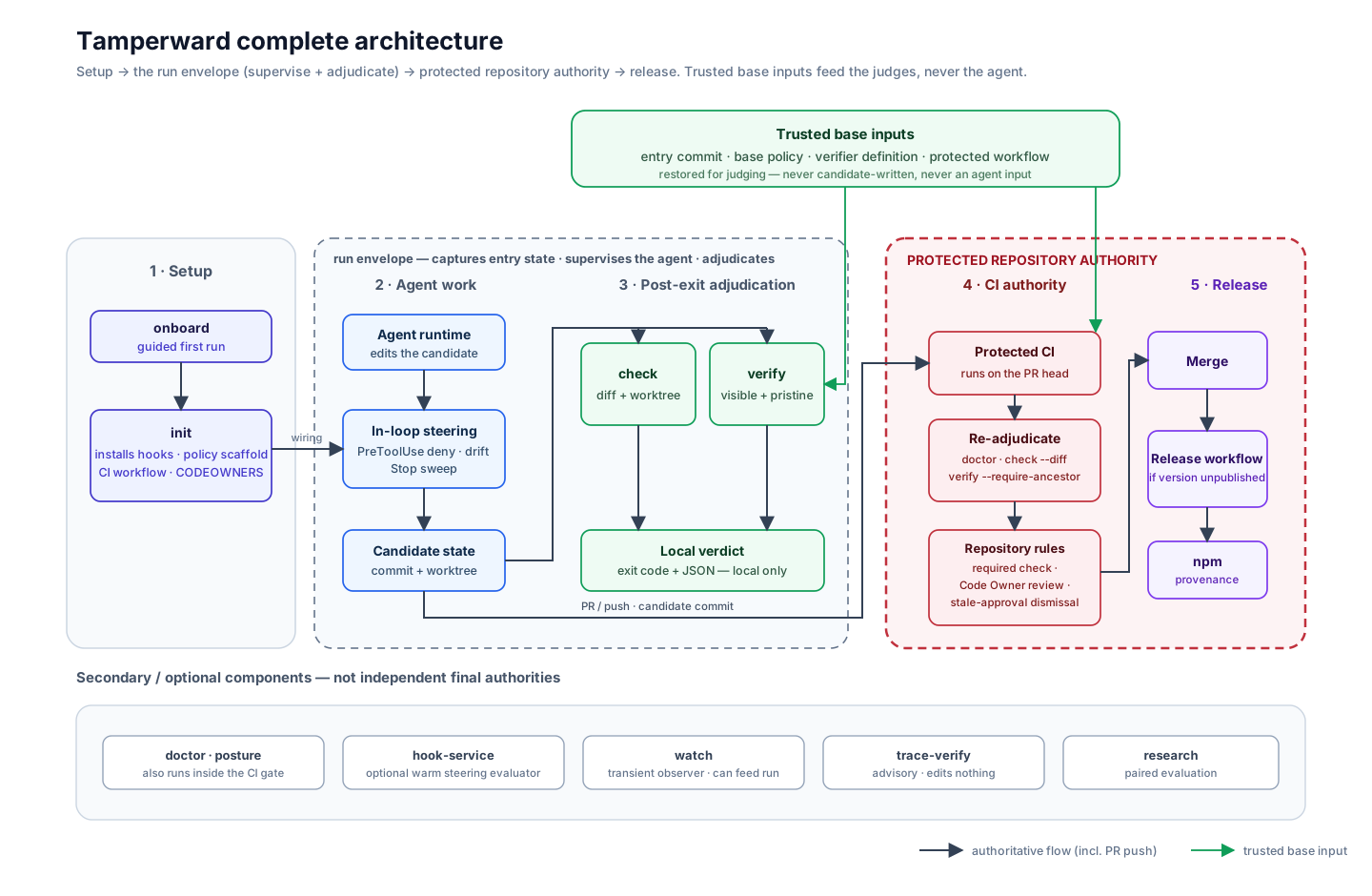
How it works: two jobs, one invariant
Tamperward sits between what the agent controls and what your repository trusts, and it does two different things:
- Steering happens while the agent works. It denies known weakening moves before they land and flags protected-state drift as it happens. Fast, in-loop, not the final authority.
- Adjudication happens outside the agent's completion path. It independently re-runs trusted verification against the candidate and reports a verdict from the suite's own exit code. This is where a masked failure — visible-green, pristine-red — is caught.
Neither path calls an LLM; the checks are deterministic. The invariant underneath both is simple:
The agent may author the candidate tree, but it must not choose the trusted baseline, governing policy, verifier, protected workflow, or final repository verdict.
See Architecture for the component-level map and the trust boundaries table.
The five enforcement surfaces
The same ruleset is applied at five points, from inside the agent's loop out to the CI authority. Each later surface is harder for the agent to influence than the one before.
in the agent's loop        at commit         in CI (the authority)
┌───────────────┐  ┌──────────────┐   ┌───────────────────────────┐
│ 1 PreToolUse  │  │ 3 pre-commit │   │ 4 check --diff  (range)   │
│   hook (deny) │  │  check       │   │ 5 verify        (pristine)│
│ 2 Stop sweep  │  │  --staged    │   │   masked-failure envelope │
└───────────────┘  └──────────────┘   └───────────────────────────┘
steer, deploy-fast gate the commit re-adjudicate from the base| # | Surface | Command | What it does |
|---|---|---|---|
| 1 | PreToolUse hook | tamperward hook claude | Denies a weakening tool call before it executes, inside Claude Code's loop. Reads the hook payload on stdin; a deny is JSON on stdout. |
| 2 | Stop sweep | tamperward sweep claude | At end of turn, re-scans the working tree (including untracked/ignored protected files) for anything the per-call hook did not see. |
| 3 | pre-commit | tamperward check --staged | Gates the staged diff at commit time. |
| 4 | CI range check | tamperward check --diff <base>...<head> | The authority. Re-adjudicates the PR range, reading policy from the merge-base so a branch cannot govern its own verdict. |
| 5 | verify envelope | tamperward verify | Re-runs your suite as-is and with protected files restored from the trusted base. Visible-green / pristine-red is a MASKED_FAILURE. |
The Linux-only tamperward run envelope wraps an agent invocation and applies surfaces 3–5 after the agent exits, treating the agent's own exit code as untrusted. See Enforcement & sign-off for the sign-off model and the fail-closed rule that governs every surface.
Choose your path
| You want to… | Go to |
|---|---|
| Protect a repository in about five minutes | Quickstart |
| Understand every command, flag, and exit code | CLI reference |
Consume --json / --format github from a program or CI | Machine output |
Configure .tamperward.yml (verify block, protected globs, sign-off) | Policy reference |
Look up what 0 / 1 / 2 / 124 mean | Exit codes |
| Wire CI, pre-commit, and the in-loop hook | Integrate |
| Protect Claude Code, Codex, or another runtime | Runtime adapters |
| See what the gate does and does not cover | Threat model: adjudication boundary |
| Read the measured evidence, including the refuted bets | Research & evidence |
What is outside its authority
A gate that oversells its coverage is worse than one that names its edge:
- Repository authority lives on your host. The required status check, Code Owner enforcement, and stale-review dismissal are GitHub settings. Tamperward generates and checks them but cannot enforce them from inside an npm process, which is why
doctorreports them rather than hiding the gap. - Platform coverage is not uniform. The authoritative
runlifecycle is Linux-only; on macOS you still get steering and checkpointed-localverify; on Windows checkpointed-localverifyis unsupported and fails closed. See platform support.
Treat Tamperward as one layer of defence in depth — alongside protected CI, independent tests, and human review — not a replacement for them.
Project status: active research release. Tamperward is usable today, but its enforcement architecture and supporting evidence are still being hardened; see SPEC §9.1.