

Tamperward architecture
This page is the component-level map of Tamperward. The README explains the local tamperward run lifecycle; this page shows how setup, agent steering, local adjudication, protected CI, and release fit together.
Complete architecture
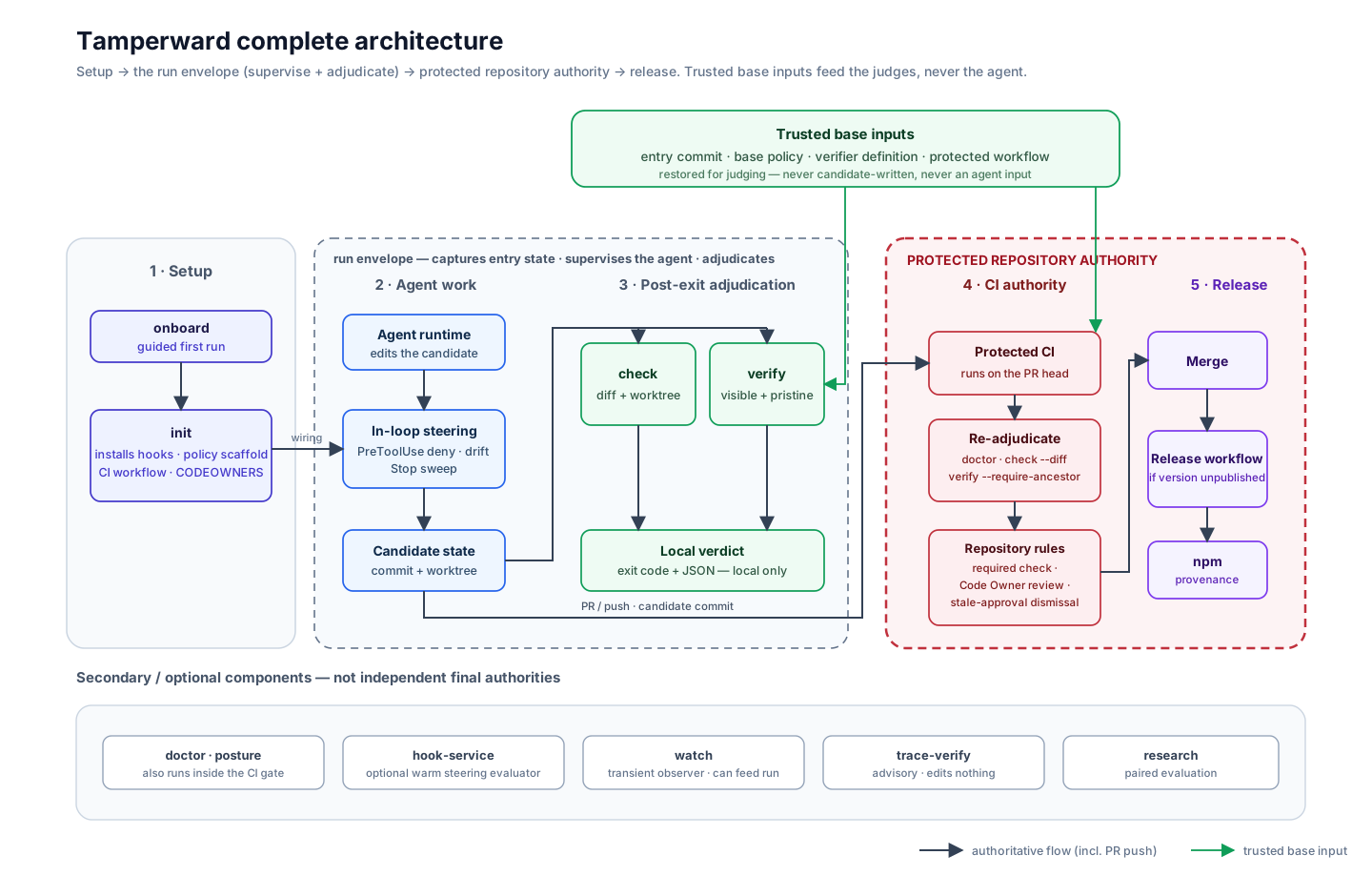
The diagram is intentionally read left to right. It shows the main decision path only; supporting and advisory tools are kept in a separate row so they do not obscure the security boundary.
How to read it
- Setup —
onboardguides first use andinitinstalls the repository wiring: hooks, the.tamperward.ymlpolicy, CI integration, and CODEOWNERS.initdeliberately does not invent a trustedverify.command; onboarding saves one only after explicit operator acceptance. - Agent work — the coding agent edits the candidate tree. In-loop hooks can deny known weakening operations and detect protected-state drift while work is happening. These hooks steer; they are not the final authority.
- Local adjudication —
tamperward runowns the lifecycle boundary. After the agent exits, it independently judges the resulting candidate withcheckandverify, then emits one local verdict. - Repository authority — protected CI sits across the trust boundary. The pull request runs the workflow on its own head, so authority does not come from the workflow copy being trusted; it comes from the repository rules around it — a required
tamperwardcheck, Code Owner review, and dismissal of stale approvals — re-adjudicating the candidate against the trusted base. - Release — only a commit that reaches protected
maincan enter the release path and become the published npm package.
The green Trusted inputs bar is deliberately separate from the candidate flow. The core invariant is:
The agent may author the candidate tree, but it must not choose the trusted baseline, governing policy, verifier, protected workflow, or final repository verdict.
Why the diagram is shaped this way
The architecture has two different jobs and they should not be confused:
- Steering happens while the agent is working. It provides fast feedback and can stop known weakening moves before they land.
- Adjudication happens outside the agent's normal completion path. It asks what actually changed and whether the candidate still passes when trusted verification state is restored.
Local adjudication is valuable because it gives immediate, independent feedback, but the repository authority is the final merge boundary. A process sharing the agent's host and filesystem is not equivalent to protected CI.
Supporting commands such as doctor, hook-service, watch, trace-verify, and research are shown below the primary path because they assist setup, observation, diagnosis, or evaluation without being separate final-verdict authorities.
Trust boundaries
| Boundary | Trusted input | Candidate-controlled input | Result |
|---|---|---|---|
| In-loop steering | Installed Tamperward wiring and protected-state reads | Tool-call payload and working tree | Immediate deny or correction signal |
| Local envelope | Entry commit, base policy, verifier definition, lifecycle supervisor | Agent process, exit code, candidate tree | Independent post-exit adjudication |
| Verification | Base-restored protected files and trusted command definition | Candidate implementation and runtime effects | Visible/pristine outcome |
| Repository authority | Protected workflow, required checks, branch rules | Pull request contents and proposed commit | Merge allowed or refused |
| Release | Reviewed commit on protected main and trusted publishing identity | Version metadata within that reviewed commit | Published package or failed release |
Main data flow
1. Establish the trusted starting point
init writes the supported enforcement surfaces: local hook wiring, the committed .tamperward.yml policy (its verifier command is left unset — init never invents a trusted verify.command; onboard saves one only after explicit operator acceptance), the repository workflow, and CODEOWNERS. onboard is the guided path around setup and posture checks.
At the start of an adjudicated run, Tamperward freezes the entry state used as the trusted reference. Candidate changes are judged against that state; they do not redefine it.
2. Steer the agent while it works
Supported hooks call tamperward hook for live decisions. The Stop hook sweeps the turn's net changes. The optional hook-service can evaluate the same hook payloads from a warm process, and tamperward watch can observe transient filesystem activity.
These surfaces reduce the chance of a weakening move surviving, but they are not relied on as the final proof of integrity.
3. Adjudicate the released candidate
tamperward run supervises the agent lifecycle and then evaluates the state left behind.
checkevaluates committed and worktree changes for protected weakening classes.verifyruns the candidate visibly and again with the protected verification surface restored from the trusted base.- ancestry, dependency, and quiescence checks protect the adjudication boundary itself.
Those signals converge on one local exit verdict and machine-readable report.
4. Re-adjudicate in protected CI
The generated repository workflow repeats the relevant posture, diff, and verification checks against the trusted base. A pull request runs that workflow from its own head and a required check is matched by job name, so the workflow copy is not intrinsically trusted; the authority is the repository rules around it — the required tamperward status check, Code Owner review (CODEOWNERS over the gate-critical paths), and dismissal of stale approvals when new commits are pushed. Those three controls, enforced by branch protection, decide whether the candidate may reach main.
This is the key authority separation: the pull request proposes code, but it does not get to replace the protected rules that decide whether that proposal is accepted.
5. Release reviewed main
The release workflow runs on pushes to protected main, but publishes only when the reviewed package version is not already on the registry; an ordinary merge that does not change the version is a no-op. When it does publish, it records the release and tag using the trusted publishing path.
Supporting tools
These commands are intentionally outside the main arrow path in the diagram:
| Tool | Role |
|---|---|
doctor | Reports repository posture and wiring. A diagnosis, not a verdict. |
hook-service | Optional warm evaluator for supported hook payloads. |
watch | Optional observer for transient protected-state mutations. |
trace-verify | Observes verifier reads and proposes verify.inputs entries for human review; it does not edit policy. |
research | Runs paired evaluations using the same underlying check and verify primitives. |
Compatibility
The architecture is a standalone, dependency-free SVG (architecture.svg) referenced as a Markdown image rather than an inline Mermaid graph.
That keeps the same layout on GitHub, the VitePress documentation site, Markdown previewers, and older browser clients without depending on a Mermaid runtime. The SVG is self-contained, uses a generic system-font stack, has no scripts or external assets, and includes <title> / <desc> accessibility text.
The diagram deliberately avoids encoding every implementation relationship as an arrow. Only the primary security flow and trusted-input feeds are connected; secondary tools are grouped separately. Detailed lifecycle mechanics remain in the README's local enforcement diagram and the implementation/specification docs.